
As someone who has been teaching for over 30 years, I have marveled at the evolution of teaching and education in general during not only my tenure, but during my lifetime. Prior to COVID-19, I was discussing this with a friend and colleague. We are both Early Childhood Special Education teachers and had just finished a marathon IEP meeting, which took us out of the classroom for almost two hours. This was just the meeting. The preparation time for the meeting, the amount of data collection needed, the testing, the communication with team members, lining up a translator, not to mention the amount of paperwork necessary to close out the IEP was daunting and resulted in hours of time which took away from our planning, instruction, personal time and most importantly our interactions with our students. And this was just ONE meeting for ONE student! We were musing over the fact that when we were with our students, we were happy and sure that we had chosen the right profession, but the paperwork was crippling. It was not much of an exaggeration to say that teaching has become the smallest part of our job. This was prior to COVID-19. Post COVID-19 only brought this to light and underscored many things I have been wondering for years, most notable, when did a teacher stop being an educator???
A teacher by definition is “a Person who teaches, especially in a school” School is defined as “an institution for educating students.” When did we move away from all this? I have been seeing the signs for years, but it wasn’t until the global pandemic of COVID-19, that it all began to gel for me. Schools are no longer just about “educating”. Teachers are no longer educators. We are counselors, nurses, nutritionists, babysitters, social workers, therapists, interpreters. There is little room for you know….teaching anymore. In short, we have become a Walmart Super Center of sorts for all society’s needs. This is disturbing on many fronts, a few of which I will tackle today.

When our school board decided our schools would start virtually in the Fall, you would think that an alien invasion, the likes of which was only seen in movies like “Independence Day” and “War of the Worlds” had commenced. Parents began to decry “I have to go back to work. Who is going to watch my children?” “This is a teacher’s job. If they don’t like it, find another career.” “My child is bored and depressed.” “What am I supposed to do with my child all day?” “What about her prom? Her graduation??” Social crusaders were yelling “Some children depend on receiving breakfast and lunch at school. How will they eat? “”What about the child who is in a stressful home situation, where will he find comfort?” “What about English Language learners, who will help them?” “Children need to socialize. Who will they play with? ” These were just some of the comments hurled at educators and the school board during a global pandemic that no one had any control over and it really started the wheels going in my already overworked brain. Schools have become all things to all people in the years since I have started teaching, not to mention in the years since I myself was in school. Is this why we are falling behind academically in comparison to international schools? Are funds that at one time went to materials, resources, educator salaries, professional development, building maintenance, training, now being funneled into a variety of roles that have nothing to do with actual education? It gave me pause and made me realize that how the public sees teachers is not how most of us see ourselves.
When our district asked us how many of us were comfortable going into the classroom as COVID cases rose in our area, 10% of teachers requested ADA (Americans with Disabilities) accommodations for virtual learning . Many of us were in high risk categories and qualified for accommodations. Those whose physical condition didn’t allow for ADA accommodations, but felt going into a classroom was unsafe for either themselves or a high risk family member, filed paperwork for LOA (Leave of absence). Before the announcement to virtual was made, there were twice as many LOA requests as in previous years, a number that would surely have risen had the decision to teach in person been made. Resignations and early retirements were also up in number. Substitute teachers, already at a premium, especially in special education classes, became practically non-existent. At the end of the day, there simply were not enough teachers to teach in person. It was at that point, that teachers became targets for every parent who needed childcare or a break from their kids. We were called “lazy”, “uncaring”, “inconsiderate”, among the nicer terms. We were asked if grocery store workers and health care workers could go to work why can’t we?? We were villainized because we were concerned about our health or the health of a loved one. No one seemed to consider the fact that health care workers are trained and have the best PPE equipment, as they should, and grocery store workers are not in a classroom often the size of a large closet, with a full class of young children who would never be able to put on a mask or social distance for 7 hours a day…or even seven minutes a day for that matter. Teaching a classroom of young children is not like anything else. Classrooms are petri dishes of germs and disease in a good year, let alone a year with a global pandemic. Our youngest students sneeze on us, use our clothing as tissues, drool on us, cry on us, have toileting accidents, lick us, materials and each other and well….you get the picture. Add to that the fact that parents often send their children to school sick because they can’t take anymore time off from work, have an important meeting etc. Often a child will come to school looking ill, but with no fever. In a few hours, a fever will appear and we are allowed to call the parents to pick up the child. Of course, at that time, school is almost over. We often found once the child is in the building that the child was given “medicine” before school to make him feel better. Maybe it kept his fever down for a few hours, but in the meantime, this child contaminated the entire class including teachers. Normally, it is just an inconvenience as teachers and students pick up whatever bug the child brought to school. At most, it would mean children being out sick (likely inconveniencing other parents who would now have to take off to care for their own child) or teachers being out sick and praying a substitute could be found. But just imagine how devastating that scenario would be with a virus as deadly as COVID-19? The impact it could have on teachers, their families as well as students and their families? And do parents not look at what the actual school day would look like if we taught in person? My students, (ages 2-5) would not be able to social distance nor wear masks. Half the time, we can’t even get them to keep their shoes on! To protect us, we would have to wear gowns, gloves, masks, and face shields. We would have to change every time we had to change a child or “console” them.

Aside from our students being afraid of us in all this gear, one of us would be in the bathroom changing our gear all day! I’m not sure a school budget that can’t even provide enough hand sanitizer for the year would be able to keep up with the amount of gowns necessary under that scenario. I have not even mentioned the impact all this gear would have on those of us of a certain age, who are already suffering from hot flashes!! But aside from the comfort and fear factor, this would not be helping the children. Our students would not be able to sit near each other or us, play together nor share materials. Most of our special education students have social skills goals such as sharing and turn-taking. Not only could these goals not be met, but we would in fact, be teaching them the opposite. How is that not detrimental to the children? Or is the need for babysitting so essential that many parents have not considered these factors? Have those fighting for schools to be opened ever stopped to look at the gear we must wear, the distance the students must keep, the lack of socialization, the amount of cleaning that needs to be done (by the teacher of course) in between activities and classes etc. and stopped to say “Hmmmm…maybe if we need to be doing all this to keep our children safe, we really should not be reopening schools?
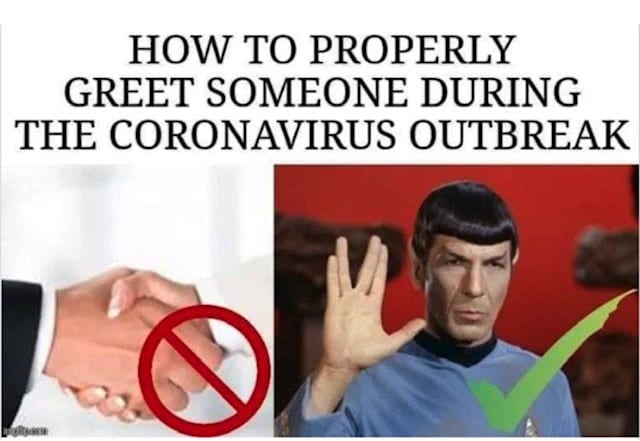
Despite what some parents think, teachers are for the most part, loving and caring people who sacrifice a great deal of their own time and money to assure their students are supported. Teachers are working nights, weekends and summers taking courses, preparing materials etc. We care about our students and our professions. We will do almost anything for our children, except, sacrifice our lives. Teachers finally had the strength to say “enough”. ” I’m not going to sacrifice my health nor the health of a family member to fix problems in society and individual homes. That is not my job. My job is to ‘educate”. When that message came through, the rest of the country was left collectively wringing their hands and saying “Now what do we do?” And without admitting it, everyone realized that teachers who have been taken advantage of by everyone from administrators to society in general, were actually important. Teachers have become the “be all’ to society. And I realized, if that is what society wants, then teachers should be paid for performing multiple jobs. If not, then find another way to meet society’s needs and let us get back to teaching. Perhaps if we were allowed to do the job we were trained to do and nothing more, American schools would begin to catch up with International schools academically. Perhaps if teachers were allowed to teach and were not so distracted with other duties, more special education students and students in general would receive a greater amount of support, allowing them to progress even further. Perhaps if teachers were allowed to “just” teach, fewer good teachers would leave the profession due to burn out. These are all legitimate considerations.

Does this make me an “uncaring” teacher? Of course not. I spend a great deal of my own money on materials for my classroom and individual students. I contact families to share good news as well as concerns. I send out cards to families on the birth of a new baby or the death of a loved one. When my own father was dying in the spring, rather than take a leave of absence to totally focus on him, I continued to teach virtually, knowing that my preschool special education students were struggling and I didn’t want to add stress to an already stressful situation. I taught during the day and took care of him at night, in between creating lessons etc. I was responding to a few emails the night after my father’s funeral. So do not tell me I don’t care. The truth is that often, like most teachers, I care too much. But as a teacher, not as a babysitter, or therapist or social worker. I need to have the time to do my job properly for the sake of my students as well as for my own sanity. Teachers have always cared about their students to the point of going into work not feeling well, or when in the middle of a family crisis because we know how difficult it is to find a decent substitute and we hate to leave our students. We traditionally do all that is asked of us and more…much more. Over the years, our responsibilities have continued to rise while our pay did not. We do this because we love our students and are committed to our profession. This is the one time teachers put themselves first. We have to value our health and our lives or we cannot teach anyone. So yes, when I hear that I am acting unprofessionally or selfishly it bothers me. Teachers are highly educated and must continue to take professional development in order to maintain our licenses. We are professionals and deserve to be treated as such. We acted professionally when we were treated as anything but. We spent the majority of our careers putting students first. This time, we chose our own health. We are not selfish. We are practicing “self-care”, a term used by schools ad nauseum each year during training, as administrators remind us to take care of ourselves, so we will have the energy to take care of our students. We are doing that now.
I don’t have many answers as to what parents can do to help with daycare or mental health. I do not feel it is the job of the schools, nor do I necessarily feel it is the job of the federal government. Creating more services will only continue to drive up an already out of control national debt and taxes. But why can’t private sectors step up? Parents who are trying to go back to work are complaining about daycare. Schools are not daycare. Perhaps their companies should step up to provide decent, low cost daycare to help their families. And we’re told that children are bored and getting depressed while not in school. These are unprecedented times. Many adults are also bored and depressed. But it is not up to the schools to deal with this. Parents need to help their children and if they can’t, then seek counseling. My son went through a very severe depression while in high school. I did not look for school to be a solution. I took him to a therapist and followed his instructions. People need to take responsibility for their own situations and not expect schools to take it off their plates. Parents often counter that Insurance doesn’t always cover mental health and counseling, and while I again, I am sympathetic and in this case, empathetic, , why is this a problem for education? I do feel terribly for children who are in a stressful home environment or who don’t speak English, but to be blunt why is this a school’s problem? A teacher’s job is to teach, not to solve nor fill a void in mental health care, nutrition, daycare, or language.

When I began working in public education, I was shocked at the amount of time and money paid to interpreters. My grandparents were immigrants. I am very pro-immigrant, but my grandparents recognized that they moved to a new country and must learn the language. My father and his siblings were told to learn English. They still spoke Italian at home and carried out their traditions, many of which, I still do to this day, but “outside’ they needed to learn English. When did that become a ‘bad’ or “racist’ way of thinking? I have had families who have lived in this country for 10+ years who still do not speak English. The result is an incredible amount of extra time, effort, and expense for schools. Each time I talk to a non-English speaking parent for a conference, meeting or even phone call ( and in special education, that amount of time is vast), I need to first find an interpreter, then try to arrange a mutually convenient time for the meeting, then submit paperwork for payment for that interpreter. In a small county, perhaps this is not a problem, but in my county over 50% of our families speak a language other than English at home. There are many adult education centers that offer English classes. Perhaps we need to get the word out and/or make these classes more accessible to families as a society? Learning the language used in your child’s school can only help form a better alliance with your child’s teacher on many levels, while reducing the time and cost of interpretation services. It would also help the family in general. I have spent so much time with parents who want to help their child but either don’t understand the services explained to them or misunderstand the wording in emails. Finding more convenient ways to learn English would be helpful to so many families on so many levels, while helping education become more efficient for our non-English speaking families.
Since our schools have begun taking on many of these roles, our educational standards and rankings have been slipping. Perhaps the old adage, ‘Jack of all trades, master of none, ” is true. Teachers need to be able to get back to mastering our profession: teaching. Parents need to realize that ultimately, responsibility for their child’s welfare is theirs and society needs to find a way to support families in non-education areas. Children whose families cannot afford food, need to be fed. Children in stressful home situations, need to be counseled and cared for. Children whose parents do not speak English need to be aided. But all these things should not be the responsibility of our school system. If things continue as they are, schools will continue to fail, and good teachers will be harder to find. Teachers are already leaving the profession for jobs that are less stressful, one that will give them back a life and provide payment commensurate with their education and experience.
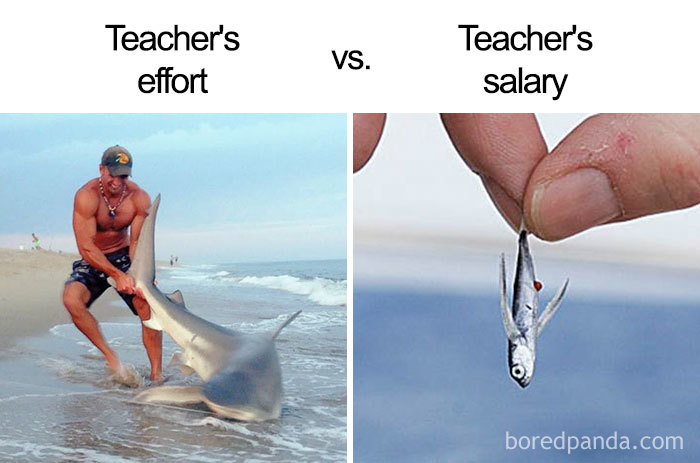
I will be retiring soon and my children are grown, so I will not be part of this equation. These questions will be for a new generation to figure out. But I do fear for my fellow educators and future students who will suffer if this is not rectified…..and soon. Something needs to be done if we are to keep and encourage promising young teachers. Or maybe educators will just decide to stop fighting altogether and become babysitters….Hey….it pays better and you don’t have the headaches and paperwork!!

 New Endings